Is Candy96 Legit? Licence, Ownership and Trust Signals
The current material does not establish a simple “legit” or “scam” label. No Australian local licence was available for Candy96, Candy 96, Wonder Four Limited or 96Group in ACMA’s current register of licensed interactive gambling providers. Candy96 identifies itself with 96Group, while the current official 96Group legal footer says 96group.com is operated by Wonder Four Limited and licensed under the Anjouan jurisdiction. That group-level statement should not be rewritten as proof that Candy96 itself holds a separate Australian licence or a separately supported Anjouan domain registration. The overview therefore ranks trust details by reference: Australian regulator first, official group and brand material next, independent review data after that, and user reviews as anecdotal experience rather than proof.
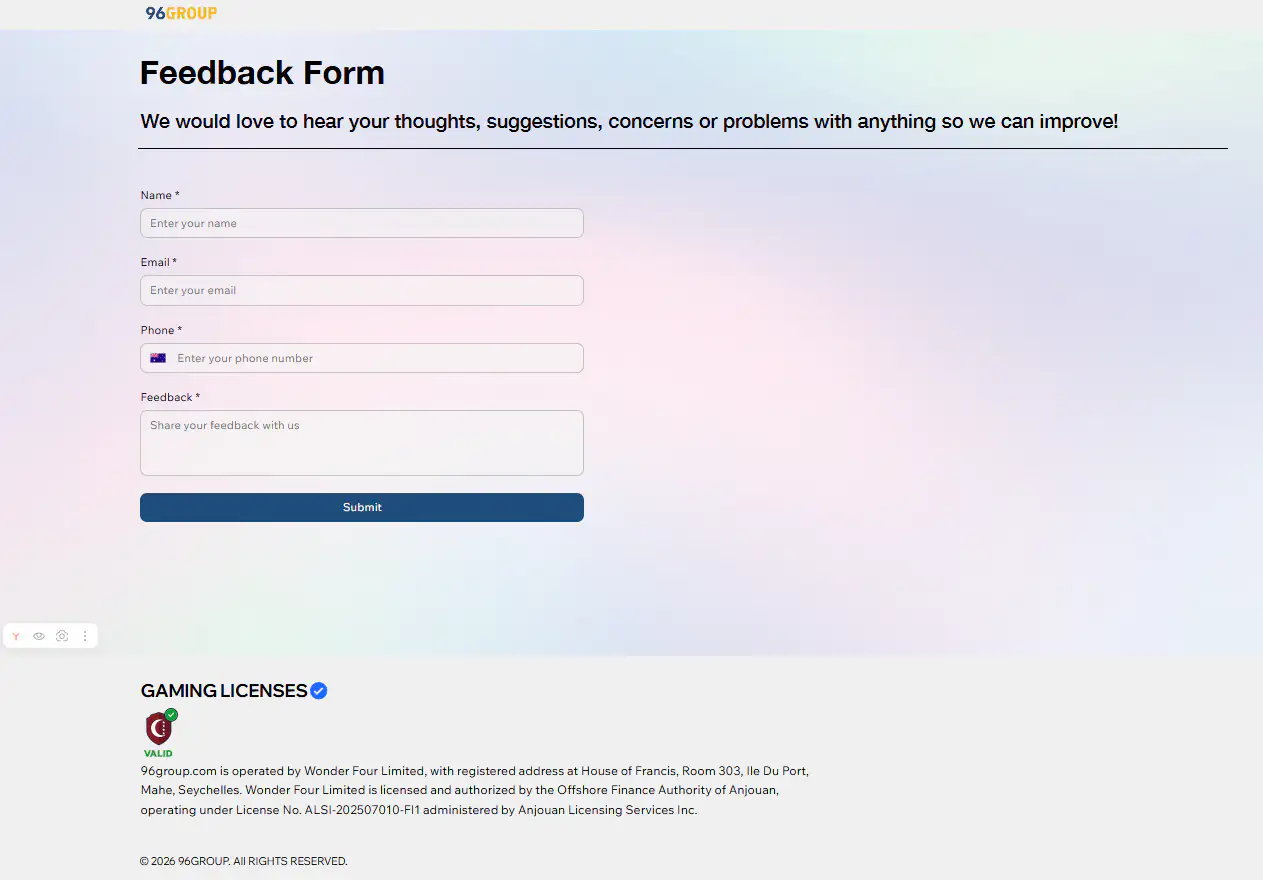
Table of Contents
- The trust answer in one table
- Trust signals need context
- No Australian local licence was available
- What the 96Group details actually says
- Why do not rely on a Candy96 Curaçao licence
- Game integrity is a separate signal
- Payments provide operational details, not a licence
- Reputation details are mixed and should stay attributed
- Brand age is a small trust signal, not a verdict
- A practical Candy96 trust checklist
- What can be concluded today
- FAQ
The trust answer in one table
| Signal | Supported position | What not to infer |
|---|---|---|
| Australian local licence | No Candy96 or checked associated-name match was found in ACMA’s licensed interactive gambling provider register. | Do not say Candy96 is Australian-licensed or covered by a local licensed-provider dispute scheme. |
| Group identity | Candy96 identifies itself with 96Group. | Do not automatically turn group membership into direct legal ownership of Candy96. |
| 96Group operator | The current official 96Group legal reference names Wonder Four Limited as operator of 96group.com. | Do not silently replace the group scope with a Candy96 corporate-ownership statement. |
| Group licence jurisdiction | The current 96Group legal reference places 96group.com under an Anjouan licence. | Do not call this an Australian licence. |
| Other licence claims | Do not rely on a Candy96 Curaçao licence as current fact. | Do not copy an unverifiable third-party licence attribution into a trust verdict. |
| Game-integrity signal | Casino Guru currently reports that a sampled Gamecheck check found no fake games. | Do not treat a sample as proof that every title is genuine or as a direct current Gamecheck certificate. |
| User reviews | Current Trustpilot material contains both positive and negative Australian withdrawal experiences. | Do not turn anecdotes or a changing score into measured payout reliability. |
Trust signals need context
Different trust signals answer different questions. For an Australian licence question, the authoritative reference is the regulator’s current provider register. For the 96Group operator and licence jurisdiction, the strongest details in current Candy96 material is the group’s current legal footer. Candy96 brand pages can establish what the brand says about itself and how it presents its services. Independent third-party sites can add useful observations, but they do not override an official regulator register for a local licence claim.
User-review platforms sit lower in the hierarchy. They are useful for identifying recurring experiences and complaint themes, but a user report cannot establish licence status, ownership or measured withdrawal performance simply by describing a personal outcome. That is why the topic links reputation details to a separate Candy96 reviews rather than using review sentiment as the legal foundation of the trust assessment.
This method also prevents a common mistake: combining one positive payment report, one licence badge and a brand slogan into a binary safety verdict. Trust signals answer different questions and should stay separated.
No Australian local licence was available
ACMA’s current page says an online wagering service must appear in the register of licensed interactive gambling providers to operate legally as a licensed interactive gambling provider in Australia. The current register was checked for Candy96, Candy 96, Wonder Four Limited and 96Group, and no matching entry was found for those names.
The correct public wording is therefore narrow: no Australian local licence was available for Candy96 in the ACMA register. It is not accurate to convert that into “Candy96 holds an Australian licence”, “Candy96 has Australian consumer protection”, or “Candy96 belongs to an Australian dispute-resolution scheme”. Those claims would require a register hit and the relevant local licensing details.
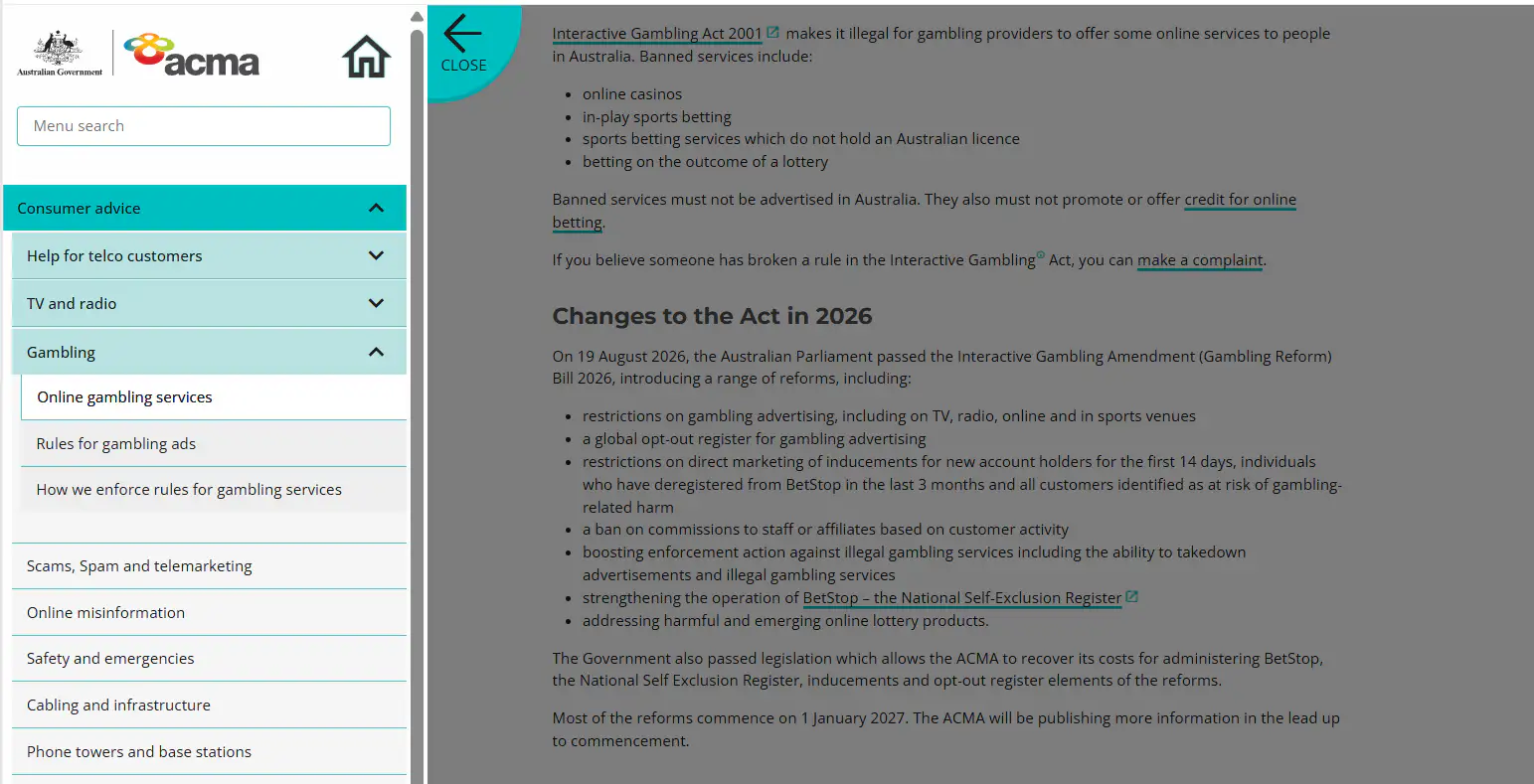
The wider legal position is also important. Australia’s federal Interactive Gambling Act framework prohibits providers from offering online casino services to people in Australia. The Australian gambling rules explains that provider-side framework and why licensed Australian wagering services are not the same category as offshore online casino services.
For readers who want to inspect the register directly, the current reference is the ACMA licensed interactive gambling provider register.
What the 96Group details actually says
Candy96 identifies itself as a member of 96Group. The current official 96Group legal statement says 96group.com is operated by Wonder Four Limited and licensed and authorised by the Offshore Finance Authority of Anjouan. That is a supported group-level jurisdiction statement.
The scope is important. Saying “96Group is operated by Wonder Four Limited” is not identical to saying “Wonder Four Limited directly owns Candy96”. The current Candy96 details used for this assessment does not justify collapsing those two statements into one. Likewise, a group-level Anjouan licence statement should not be described as an Australian licence or as proof that Candy96 is separately listed as a licensed domain in Australia.
The current group legal text can be checked at the 96Group legal footer. The topic deliberately keeps the wording at the level the reference supports instead of expanding it into a stronger ownership claim.
Why do not rely on a Candy96 Curaçao licence
Some casino-review material in current Candy96 material has carried a different operator or Curaçao licence attribution. The current reference-of-truth workflow does not treat that attribution as supported for Candy96 because it conflicts with the current 96Group details and could not be established to the licence-verification standard required for a specific licence number.
The practical result is straightforward: do not rely on a Candy96 Curaçao licence number, does not describe that jurisdiction as settled Candy96 fact and does not use it to generate a stronger trust score. A licence number is a residual high-risk fact. It needs a current regulator entry or equivalent qualifying primary details tied to the relevant operator or domain.
This is not a reason to hedge unrelated facts. The separation between licensing and product features means games, payment methods, mobile access, support and independently features keep their own details status. A missing Australian licence does not automatically make every feature claim uncertain, and a foreign group licence does not automatically validate every product claim.
Game integrity is a separate signal
Game integrity should not be inferred from licence branding alone. Casino Guru reports that a sampled Gamecheck check across multiple providers found no fake games. That sampled result does not certify the entire Candy96 library, so a specific game should still be checked separately when authenticity matters.
A sample has limits. It can be a useful positive signal about the titles checked, but it cannot prove that every game in a changing library is genuine. It also cannot replace provider-level information, a direct certification record or a regulator finding. The Candy96 games covers the current game library and provider details without turning a sampled authenticity check into a universal guarantee.
Payments provide operational details, not a licence
Candy96’s current withdrawal material gives concrete operational signals: it lists OSKO bank-transfer withdrawals to Australian accounts, says KYC can be required, requires accurate bank details and states that most withdrawals are usually processed within 5-10 minutes, with extra verification possible for larger amounts. Those are useful facts about how the service describes its cashier process.
They are not licence details. A working payment route or a fast successful cashout does not demonstrate that a casino appears in the Australian licensed-provider register. Conversely, a complaint about a delayed withdrawal does not by itself prove fraud. Payment execution, licensing and reputation should be considered separately.
For the current operator statement and user-reported timing variation, see the dedicated Candy96 withdrawals.
Reputation details are mixed and should stay attributed
Current Trustpilot material contains both positive and negative Australian withdrawal reports. Some reviewers describe quick withdrawals or helpful support, while other Australian reviewers report waiting several hours or experiencing payment problems. Those accounts are useful as examples of user experience, not as independently audited performance statistics.
The dynamic Trustpilot crawls used in current Candy96 material have also shown changing review counts and scores. For that reason, do not treat a TrustScore into the trust verdict. The stronger conclusion is the pattern itself: reputation details are mixed, and withdrawal experience is not uniform across the user reports visible in current listings.
This distinction matters when someone asks whether Candy96 is a scam. A negative review can identify a complaint that deserves scrutiny, but it is not the same as a regulator enforcement finding. A positive review can show a reported successful experience, but it is not proof of legal authorisation or a guaranteed future payout.
Brand age is a small trust signal, not a verdict
Two current independent reviews list Candy96 as established in 2024. That makes the brand relatively recent compared with long-running gambling operators, but age alone does not decide trustworthiness. A newer brand can have valid operational controls, while an older brand can still generate complaints or regulatory problems.
The useful role of the founding-year details is context. It tells readers that the public track record is comparatively short, so current operator, licence, payment and review details deserves more weight than assumptions based on longevity. The Candy96 registration covers the current account rules without treating the brand’s age as an eligibility or security guarantee.
A practical Candy96 trust checklist
- Check the regulator question separately. For Australia, look for the relevant name in ACMA’s licensed interactive gambling provider register rather than relying on a casino-review licence badge.
- Keep group and brand scope separate. 96Group operator information is useful, but it should not be rewritten as direct Candy96 ownership unless a reference explicitly establishes that relationship.
- Treat foreign jurisdiction details at the right level. The current official group reference supports Anjouan for 96Group; it does not create an Australian licence.
- Read cashier details as operational details. Withdrawal instructions and payment methods show how the service works, not whether it is locally licensed.
- Attribute game-integrity samples. A sampled check can inform a decision but cannot certify a whole changing library.
- Read user reviews for patterns, not proof. Mixed withdrawal reports can highlight risk areas without settling licence or fraud questions.
This checklist is more demanding than a single “legit” badge, but it produces a clearer answer because each claim is tied to the reference capable of proving it.
What can be concluded today
The strongest current conclusions are limited but useful. Candy96 presents itself as connected to 96Group. The current 96Group legal footer names Wonder Four Limited and the Anjouan jurisdiction. No Australian local licence was available in the ACMA register for Candy96 or the checked associated names. Current user-review details are mixed, and current independent game-integrity details is only a sampled secondary signal.
From that set of facts, the responsible answer is not “guaranteed safe” and not “proven scam”. It is a reference-ranked risk picture. Readers should distinguish operational service details from Australian authorisation, distinguish group-level licensing from brand-specific local licensing, and avoid treating either positive or negative user anecdotes as the final word.
The Candy96 review brings the separate bonus, payment, game, mobile, account and trust findings back together without letting the licence question erase independently feature details.
FAQ
Is Candy96 licensed in Australia?
No Australian local licence was available for Candy96 in ACMA’s current register of licensed interactive gambling providers.
Who operates 96Group?
The current official 96Group legal statement says 96group.com is operated by Wonder Four Limited.
What licence jurisdiction does 96Group state?
The current official 96Group legal reference places the group under an Anjouan licence. This is a group-level statement and should not be described as an Australian licence.
Does Candy96 have a supported Curaçao licence?
Do not rely on a Candy96 Curaçao licence as current fact because current Candy96 material details does not meet the required verification standard for that claim.
Do reviews prove Candy96 is safe or a scam?
No. User reviews provide anecdotal experience. Current Trustpilot material includes both positive and negative Australian reports, so it is more useful for identifying patterns than for proving legal status or guaranteed payout performance.
Published by the Candy 96 Casino team.